by Sama’at Sakuhai
‘When elephants fight, it is the grass that suffers.’
At the time of this writing, fifty-three days have passed since the United States and its ally Israel launched “Operation Epic Fury” and “Operation Roaring Lion” respectively, in a joint coordinated strike against Iran. Headlines stated:
"U.S. Central Command (CENTCOM) commenced Operation Epic Fury at the direction of the President of the United States. CENTCOM forces are striking targets to dismantle the Iranian regime’s security apparatus, prioritizing locations that pose an imminent threat."
Launched at 1:15 a.m. on February 28th, 2026, the conflict had been fomenting for decades prior. The justifications offered as pretexts bring to mind the aphorism, “When you want to drown your dog, accuse it of madness.” Hence, accusations flew, and with them came the perceived rationale for an open attack. This is despite the pretense of diplomatic negotiations taking place between the respective governments. It was reported that the U.S. and Israel’s opening salvo into this latest conflagration was responsible, among other initial operational strikes, for the targeting and bombing of a school full of children. The all-girls school was later reported to have suffered casualties of between 150 and 175 school girls and staff.
Retaliatory measures taken by Iran included the bombing of Israeli cities and various other forward operating bases hosted by the Gulf Cooperation Council (GCC), which are U.S.-allied surrounding countries that are being used as military proxies by the U.S. in the region. All told, in just the past seven weeks or so, the death toll has reached into the thousands, with tens of thousands more injured, and upwards of millions displaced. Now, nearly two months later, are they any closer to their supposed objectives? In the days, weeks, and now months, by their metrics, the world has been inching closer to the only result “Epic Fury” can yield: catastrophic collapse. Rhetoric from the U.S. administration has been filled with bluster and megalomania, reflecting a mindset commensurate with empire. For instance, in a public statement from the Secretary of the Department of Defense/War a few weeks ago, it was brazenly and paradoxically declared that “We negotiate with bombs.” These provocative proclamations were made even from the same podium and by the same official who is keen to use this platform to purport his “Christian” values. Not a few weeks later, an entire civilization was threatened with annihilation by the Commander-in-Chief, perplexingly in an effort to engender the cooperation of the same ‘regime’ whose supreme leader, the Ayatollah Khomeini, they had assassinated with one of their ‘negotiating bombs’, a few short days after the beginning of this conflict.
It seems like forever ago since the first U.S. military casualties were reported. Those initial six U.S. soldiers, in contrast to the hundreds of Iranian lives lost on the other side that Western authorities deigned to report, all met their untimely demise in this descent into the mouth of madness. And while the world saw and some mourned those losses, each from the perspective of their politicized, perhaps patriotic, biases, they’ve collectively felt the subsequent financial fallout, which appears to hurt the most. Indeed, for those of us reading or receiving these reports thousands of miles removed, from the safety of our undisturbed distance, where the thunder of erupting ordnance is not rattling our double-pane windows, where the night sky is not set ablaze by the crimson flash of detonating munitions, and the trepidation of knowing that any moment could be our last, the gravity of this aggression is assessed economically.
We’ve all likely felt the pinch at the gas pump, in grocery stores, and in myriad other related ways. Consumers in the free market economy of the imperial capitalist system are made to pay the financial cost of these resource wars, as our addiction to energy consumption, oil (the blood of the Earth) being the primary source, continues unabated.
But what of those resources? Where do they come from, and at what cost to the environment, the natural world, and the life of the nameless who become the inadvertent collateral of our appetite and those who profit from it? This is the damage that isn't captured in the body count and doesn’t move the stock ticker. These are the elements taken for granted, aside from the human toll and the financial repercussions whenever an attack order is issued. The political leaders clearly value and consider these apparently benign realities even less.
From the land to the sky and the seas where the three meet, there has been untold collateral damage. One major flashpoint of this conflict is the Strait of Hormuz, extending into the Gulf of Oman and the Persian Gulf, where already environmentally hazardous maritime traffic poses an inherent threat. Now, in the ensuing volley of retaliatory attacks, both the Iranian Revolutionary Guard (IRGC) and U.S. and Israeli forces have reportedly fired on and sunk numerous Iranian naval ships and struck oil tankers and coastal refineries, leading to potentially massive oil spills. The damage to the marine ecosystem from these sunken vessels threatens nearby fragile coral reefs and diverse marine life, releasing toxic chemicals and heavy metals that will likely persist for decades.
On land, aside from the devastation of the natural flora and fauna of the fertile southern region of Lebanon, its Ministry of Agriculture reports that 22% of Lebanon’s total farmland (roughly 190 square miles) has been destroyed or rendered unusable. This destruction is a result of ordinance and reports of the use of white phosphorus, which has contaminated the soil with heavy metals that will affect crop safety for years.
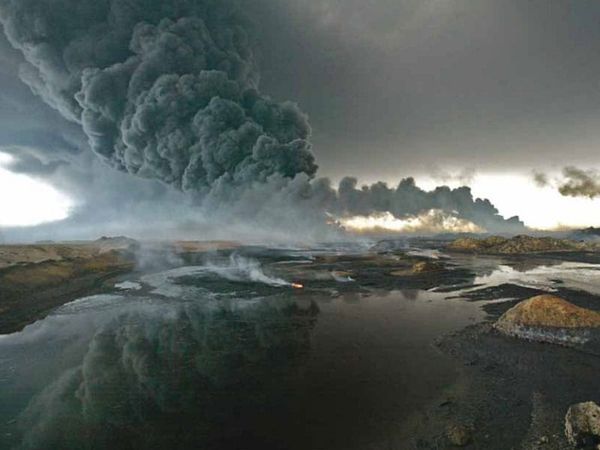
Meanwhile, “Black Rain” has been falling from the sky as toxic precipitation carrying soot, sulfur dioxide, and heavy metals has followed strikes in Tehran and other major Iranian cities, according to UN warnings. This doesn’t stay in one spot; the smog and toxic plumes from burning oil infrastructure have blanketed urban and rural areas, covering roughly 1,500 to 2,000 square miles across the Alborz mountain range and the Gulf coast. Significantly, the migratory birds and local fauna in northern Iran are facing respiratory failure and contaminated water sources due to this acidic runoff.
Politically, the miasma among the ranks of its representatives is palpable and beggars belief at the very top. Reports of insider trading and betting on whether bombs will be dropped and whether ‘negotiations’ will be resumed have become commonplace. The incoherent vacillation of the U.S. administration over its bombastic ultimatums has only exacerbated uncertainty and thwarted the rapidly waning possibility of de-escalating the insanity. As a result, geopolitical machinations indicate that, in this era of growing uncertainty, the lines of the political and economic power structure will be radically redrawn, which can only lead to more conflict as the sun sets on the U.S. global empire. So, while these few elephants fight and the area of their direct confrontation is still relatively contained, the ecological and human shadow of the conflict now covers an immense region, with untold knock-on effects in its wake for decades to come. The question becomes: what happens if this fight escalates in scale and more ‘elephants,’ jockeying for the top position, join this war, as political rumors foreshadow? What happens to all the suffering grass?