Alienation and the ‘South African’ Dilemma (Pt. 2): The Architecture of Alienation
The question before us is not simply why xenophobia has resurfaced in South Africa, but how Africans came to regard one another as strangers in the first place.
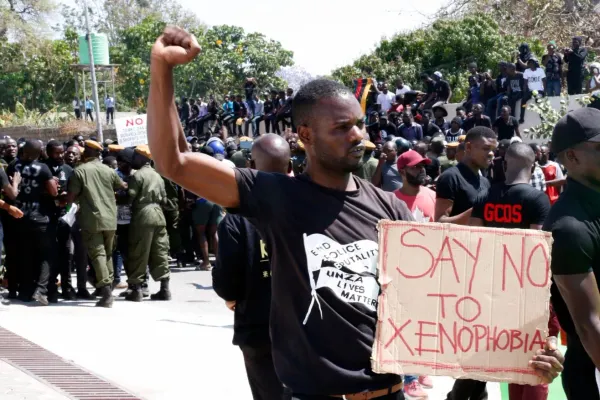
A protestor gestures and holds a placard during a demonstration in front of the South African Embassy in Lusaka, Zambia on September 4, 2019 SALIM DAWOOD/AFP/AFP/Getty Images)
By Sama’at Sakuhai
The question before us is not simply why xenophobia has resurfaced in South Africa, but how Africans came to regard one another as strangers in the first place. Economic hardship, political opportunism, and modern immigration policy may explain why tensions erupt, but they do not explain why that frustration is so often directed at another African.
Perhaps no observation captures this dilemma more succinctly than one made by Dr. Nkosazana Dlamini Zuma:
“The universe, or God depending on how you look at it, created Africa (Meritah). We South Africans, Ghanaians, whatever, were created by the Berlin Conference. We are Africans because these different nationalities were not created by us or the universe. They were created by our colonizers.”
Whether one agrees with her assessment in its entirety or not, it raises a profound question. To what extent have the political identities inherited from colonial rule reshaped how Africans perceive one another, and how central are those identities to the present dilemma?
Before we can understand what was lost, we must first understand what existed, because the present dilemma only makes sense against what came before.
Before Berlin: Meritah’s Own Governance Structures
Long before the event that would alter the civilizational landscape of Meritah (an older name for the continent now known as Africa, used here to signal a civilizational identity predating the colonial map), the continent already held diverse, organized societies stretching from the Mediterranean to the Cape and from the Atlantic to the Indian Ocean.
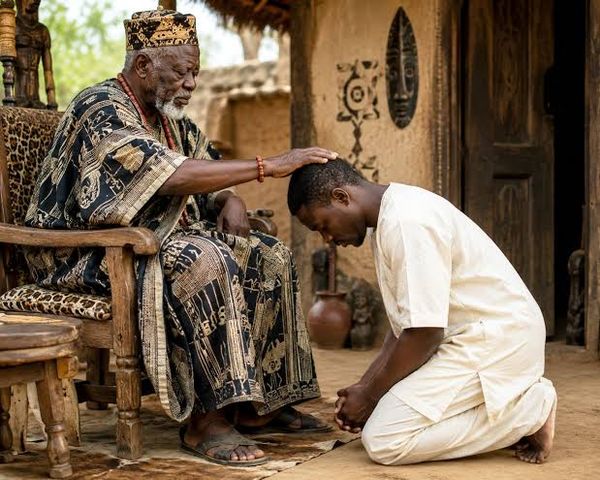
These were not empty lands awaiting discovery, nor politically vacant spaces awaiting administration. They were functioning societies with their own institutions of governance, value systems, diplomacy, commerce, and rooted traditions of royalty with Divine legitimacy as the basis of rulership. In that earlier era, Meritah and its institutions, temples, royalty, and initiations still held sway.
Africa’s political landscape, as it were, was neither monolithic nor static. Its societies could be matriarchal or patriarchal and could be organized in a remarkable variety of forms, from kingdoms, empires, and city-states to federations, confederations, and acephalous (“stateless”) societies governed through sophisticated customary institutions. Their diversity reflected the unique histories, environments, philosophies, and adaptations of the peoples who inhabited them rather than any absence of civilizational order.
The Asante, Oyo, Wassoulou, and Toucouleur Empires in the west come to mind, alongside the Benin Kingdom and our own royal benefactor, the Gulmu Kingdom, whose traditional institutions endure today and provide a living link to that order. In the south, east, and central regions stood Great Zimbabwe, the Kingdom of Kongo, the Lunda Kingdom, Buganda, the Ethiopian Empire, and many others whose histories remain underappreciated outside the continent. Far from being relics of a distant past, many of these states were contemporaries of the events that would soon unfold in Berlin, and several resisted the colonial incursions that followed.
This brief survey is not intended to romanticize precolonial Africa as a continent without conflict. Like every civilization, African societies knew war, conquest, diplomacy, alliances, and political rivalries. Yet these realities unfolded within indigenous systems Africans had developed over centuries to govern their affairs, regulate coexistence, and negotiate relations with neighboring peoples.
This distinction is essential. If Africa already possessed functioning political institutions of this depth, what exactly changed, and how did we arrive at a point where a Ghanaian, a Zimbabwean, or a Nigerian could come to be regarded as a “foreigner” in South Africa, or vice versa?
The answer lies in the colonial remaking of belonging, which taught Africans to read each other through imposed political categories rather than shared civilizational ones.
Only after appreciating the complexity and legitimacy of Meritah’s existing civilizational order can we fully understand the significance of what transpired in Berlin. The conference did not convene upon a political vacuum. It convened upon a continent already governed, already inhabited, and already organized according to indigenous institutions of its own.