by Gemma Owusu
THE NAMES THEY GAVE US - Colonisation, Lineage and the Dismantling of the Family
A name is what identifies people in society, but it is also much more than that. My father was born in Ghana in the late 1940s, at least ten years before Ghana gained its so-called “independence” from English colonial rule. In the 1470s, Portuguese traders referred to the area as da Mina (The Mine). Later, when the British seized control from trading companies and converted the territory into a Crown Colony in 1821, the name Gold Coast stuck, reflecting the ongoing extraction of people and gold.
Queen Victoria’s forces fought numerous wars with the Asante Empire, culminating in the 1874 destruction of the Asantehene’s Palace. Following this, Queen Victoria was promised a 50,000-ounce gold indemnity. Decades later, in the 1940s and 1950s, my father and some of his siblings were given British royal names: William, George (my father), Henry and Victoria. In the 1960s, they all migrated to London to start a new life and “make it” in the Western world.
On my mother’s side, the story is similar in a different landscape. Her Ancestors came from Ireland, site of the first sustained plantation project – that is, colonization – by England. What was known as County Laois (Contae Laoises to the indigenous Gaelic) was renamed Queen’s County during the 1556 Tudor conquest ordered by Queen Mary I to honour herself. Renaming the land was a strategy of domination: replace the name, replace the people, replace the culture. At some point, those Ancestors also traveled to England to seek opportunity in the very country that had attempted to destroy them.
Both sides of my ancestry endured renaming by the same imperial force on two different continents. I was born and raised in England, inside the nation that did both, growing up with no concept of what had happened only two generations before with “the names they gave us." This conquest, this identity replacement once enforced by open violence, slowly became embedded in our politics, environment, school, friendships, culture and family dynamics. Colonisation does not end; it relocates. It finds a home inside the society and the family unit and is carried forward by the very people it displaces.
From our first entry into society, we are shaped by the place and environment we arrive in. It often goes unnoticed that we are still carrying colonial seeds within us, as individuals and as a society. I grew up in a white (or light-skinned) town with my white family and had no interest in getting to know my Irish or Ghanaian roots. All I wanted to do was hide or fit in. I had no idea who my Ancestors were on either side of my lineage. It took just one generation for names, knowledge and connection to be lost. One generation that migrated, believing “integration” meant safety for their children. Intending to protect, they withheld dialects, gifts, traditions, rituals and practices, seeing England as an unsafe place for that information to live. It was a change in ideologies, presented as normal or even modern, and operated through the mind.
In Ghana, the school system was reshaped to align with the British curriculum. Children were taught inverted narratives and told to aspire to attend universities abroad, the “modern” world and have a life outside Africa. This became another way to infiltrate families and make people unwitting participants in their own colonisation, choosing to align with the religion, values and lifestyles designed by the “white man”. Even today, many schools in Ghana promote their alignment with the British curriculum as a selling point. In Ireland, indigenous people were also pushed into a lower status. Symbolic violence seeped into institutions, schools, churches, courts, workplaces, until colonial values felt neutral, standard and legitimate.
Colonisation rebuilds the family unit in its own image. It replaces names, language, ancestral knowledge and ways of being with those of the coloniser until the colonised become instruments of their own domination. This rebuilt structure passes its fractures down the line, often without conscious awareness.
What the Family Was Built to Do
To understand how colonisation sustains itself through the family, we must ask: How is the family structured within culture, and how does that differ from the society I live in today?
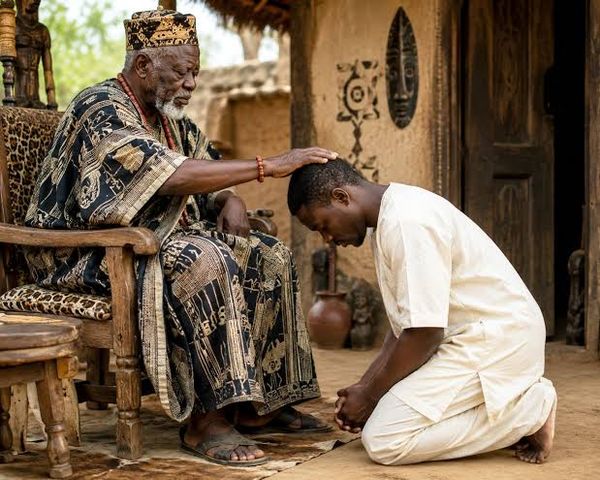
In Kemetic culture, the family is the source of human survival, the vessel through which ancestral lineage thrives and reincarnates. The family carries principles, taboos, skills, gifts and roles. Every family has a divine role assigned to it across generations, which connects to every member of the lineage. That responsibility offers power, identity and strength, but only when family members stand on it.
I did not know how to stand on mine. I didn't even know it existed. I was disconnected from my bloodline roles and gifts. I always felt something deep within me, and years later came to understand that my grandmother had passed on to me her gift of seeing light. When that path is broken through renaming, displacement, or erasure of practice, the lineage loses its direction.
There is a divine path and a route to conduct oneself in culture, a knowing of how to harmonise with something bigger than oneself. Names are a central part of life, as is language. In the Kemetic understanding, a name is not just what you are called; it is who you are connected to. It carries the Ancestors; it is a thread between the living and the dead. We know colonisation has worked when society reaches a point where you can name your children after the powers sent to destroy you.
Family in culture is the mechanism through which people sustain themselves across generations; it is how they connect to their survival. In this understanding, the family is not nuclear; it is not a mother, father, and children in a house. It is a lineage embedded in a community, connected to land, to Ancestors, to a collective purpose. What was installed in place of this architecture was not family. It was a unit. A unit encouraged to isolate and “do it alone,” to be self-sufficient, to do “what you want,” and disconnect from your lineage.
The nuclear family was an intentional fracture that became dominant in the 1800s and was cemented as a cultural ideal and norm by deliberate government policy in the 1950s. Politics, economics and industrialisation function more effectively as a form of control in this “modern” structure. Moving people from their lands to cities to make money and “be something better” encourages the transformation of multigenerational households into the 2.4-children style, severing the family from its wider network, its land and its Ancestors.
We can see in society now that this way of living is failing. Divorce rates are increasing, and non-marital single-parent households are rising sharply, which can be seen as the end product of a long chain of deliberate dismantling. Today 1 in 4 children in the UK are brought up by a single parent, compared with 1 in 14 in 1972. The encouragement of colonial and then industrial ways of life has reshaped families across generations.
I was brought up in a single-parent home from age ten. Before that, I lived with my mum and my grandfather. When I listen to stories of Kemetic culture, of children growing up and learning from their grandparents, I feel like we wasted an opportunity. I do not remember connecting really deeply with him or learning the ways of life. I was largely self-sufficient with only an eye on me.
In the 1960s and 70s, the feminist movement told women that empowerment meant entering the workforce, achieving career success and becoming financially independent. Without the village and without a collective support system, children ended up in childcare sometimes from a few months old. This was normalised to the point of collapse. This narrative told women that independence from community and family structures was “freedom”.
It moved women into individual achievement, replacing the village with a career, then handed them the children, the household, the emotional labour and the wage work, and called that progress. Around the 2010s, the “girl boss” era made the fracture even more impactful. Burnout was built on top of ambition. At this point, women were told they had to “have it all,” and if they did not, they would be seen as less than and often vilified. In a 2024 study, 93% of women reported that their work-life balance negatively impacted their mental health, and 83% of women reported experiencing physical health issues due to poor work-life balance.
In Kemetic culture, the mother is held within an entire architecture of lineage, community and ancestral connection. Strip that architecture away through colonisation and industrialisation and what is left is the mother alone.
There is now an upsurge in “modern” society recognising that this model cannot sustain family survival, and people are searching for the “lost village,” trying to replicate community and connection from within the nuclear structure.
We have created a society that thrives on individuality and being “special”, preferring separation and disconnection from self and family. You can divorce your family in the “West,” and it is seen as normal. I lost connection to my ancestry in one generation, not even being aware of my father’s parents in Ghana, separated from the wisdom, knowledge and connection from my own bloodline.
How It Got Inside
The very foundations of the plantations of Ireland and the transatlantic trade were not only economic; they were a deliberate reconstruction of people. They were about entrenching race and class as categories to justify extraction: of people, goods, wealth, resources and life. They rebuilt what was deemed ” good”, “bad" and “civilised”.
Coordinated wars and land grabs across parts of Ireland continued for hundreds of years. In 1609, following the Nine Years’ War and the Flight of the Earls, the most powerful Gaelic chieftains left Ireland and their lands were confiscated. Scottish and English settlers were planted on seized land with strict conditions. The native Irish landowning class was effectively destroyed. These new planters were Protestant, English-speaking, and loyal to the crown. The Irish were forbidden from living in the new towns built on their own land.
When English planters arrived and took over in ‘Queens County,’ they brought their language, customs, Protestant religion, and ways of cultivating land. They were not allowed to mix with the Irish or employ them. It was more than a land grab; it was the seeding of a new social order, designed to infiltrate the very structure that held the family together.
Some of my Ancestors' names were Carson and Reid, possibly Protestant planters placed on seized land and given conditional privilege in exchange for loyalty. They served as a buffer class between the Crown and the native Irish, given just enough to ensure compliance but ultimately disposable when British interests shifted. Whether the Carson or Reid clan were among those who were placed on the seized land or displaced by the seizure, I am not sure. Either way, colonial architecture shaped them.
In 1652, the Act of Settlement confiscated land from anyone who had not actively supported the English parliament. The native Irish were ordered to “go to hell or to Connaught” (far West of Ireland). Over 30,000 soldiers were deported. Up to 50,000 Irish widows and orphans were sold into slavery in the Caribbean. All priests were executed. The old Irish landowning families were almost completely destroyed.
Between the 14th and 19th centuries, the state education system was established and taught only English. Any child who spoke their native tongue was punished in various ways. One method was the bata scóir, the tally stick or score stick. A child wore a stick around their neck. Every time they were caught speaking Irish, at school, at home, in the fields, a notch was carved. At the end of the day, the notches were counted and the child was beaten accordingly.
The family administered this punishment itself. Mothers who could not speak English enforced English on their own children. Siblings reported siblings. Children stayed awake at night hoping to catch a brother speaking Irish so they could reduce their own tally. The family had become the instrument of its own cultural destruction, turning against itself in the name of survival.
This created intergenerational disconnection so deep that grandchildren could no longer communicate with their grandparents. The line of transmission through language, story, ancestral knowledge, and ways of being was broken within a single generation.
The famine in the 1840s was not only a natural disaster, as we have been led to believe through the history books. It was a state-induced catastrophe that targeted the most Irish-speaking communities with precision. The poorest, most Gaelic areas were hit hardest. At least one million people died and a further million emigrated. It was a political strategy of killing an entire way of knowing through starvation. By the time these mechanisms had operated across several centuries, English dominance had been naturalised. It felt neutral. It felt like education, like progress, like the “proper” way to speak, live and organise a family.
When Queen's University Belfast rejected Irish language signage in 2018 on the grounds that it would compromise a ‘neutral’ environment, it showed how deeply the coloniser's language had become embedded in institutions. Defending English could be framed as protecting neutrality. The dominated had internalised the values of the dominant. The clue is in the University's name.
My father's family carries the names of the British royal family. They are Ghanaian. Replacing a Ghanaian name with a British royal name severs that connection at its root. It makes the family forget what it was. It was done so thoroughly that many of the descendants -me, my sisters, and brothers - now instinctively doubt those ways of knowing as lesser, without being able to name why.
In Ghana under British colonial rule, traditional spiritual practices, ancestral connection, naming ceremonies, initiation rites- the practices through which a family maintained its connection to its lineage and its dead- were systematically suppressed or reframed as primitive, dangerous, or Satanic. Christian missionary activity was central to this process. The church became a mechanism of cultural replacement. To be ‘civilised’ was to be Christian. To maintain ancestral practice was to be backward. Families who had organised their entire lives around lineage, ancestral connection and spiritual transmission were told that the very fabric of their family life was shameful and inferior.
Whether in County Laois in the 1550s or on the Gold Coast in the 1870s, the method was the same: reprogramming to discredit native wisdom, languages and philosophies, to assert the idea of English intellectual superiority. The stripping of names, heritage, shrines and histories runs deep in both sides of my family's lineages. Then came the installation of new institutions, ideas, rules, schools, and churches. The coloniser's values were presented as neutral, natural and superior. And then they left. Because by the time you leave, the family is doing the work for you. And it was not just Ireland and Africa that were impacted. The same architecture has shaped the world, and everyone who has been growing up in that false story since.
How It Continues
What does colonisation build into the humans it leaves behind? People like me, with two fractured lineages; raised inside the colonising nation. The conditioning was inherited as normal. The silence. The disconnection. The fracture is so complete it no longer announces itself as fracture; it’s just life.
I only dived deeper into who my Ancestors were after starting M’TAM initiation. I did not find it unusual that I did not know my father’s, parents’ names or anything about their lives across the globe. My Ghanaian grandfather on my father’s side and my great-grandfathers on both maternal sides were all called John, which I found out since initiation.
I am the only dual-heritage (white/Ghanian) person in my family on either side. I grew up with my mother and my white family and had no desire to really know my Ghanaian side. I used to avoid using my African surname Owusu (meaning strong, mighty, or powerful, and associated with leadership, resilience and status, connected to the Oyoko royal lineage of the Ashanti) I used my mum's maiden name, Jackson (meaning “Son of Jack” or “Son of John”).
Where possible, I replaced Owusu with Jackson, the 24th most common surname in England and Wales, a name belonging to nobody in particular. That felt safer. After researching, I realised I had replaced my Akan royal warrior name with a name that literally means “son of” the very name colonisation gave my Ghanaian Ancestor. I never used my African middle name, Afriyie (meaning something precious, something of great value), named after my grandma. I didn’t even know how to spell it.
My school, neighbourhood, and friends were all white, with a sprinkle of Pakistani/ Indian communities, whose parents did not allow them to mix with us. I was never taught anything about my mother’s Irish side or my father's Ghanaian side. I do not think my mother really knew the history of Ireland or Ghana to teach me anyway. Similarly, my father did not teach me about his culture, food, or language. He never wanted us to speak or learn Twi while living in England, even though he still spoke it with his siblings and ate the food at home.
There was an ambition to leave all that behind for the promise of a better life, and at the same time a commitment to send money to Ghana and build a house for me, with the desire to one day return “home”. Recently, I asked my dad, since being in initiation, whether he would want to move back to Ghana now that he has retired. He said, “No, three months a year is enough.” I asked, “When you die, is it important to be in Ghana and do a ceremony properly? He laughed and said he did not think so.
Our school history classes were about the Russian Empire and the women's suffrage movement, everything except the brutal and barbaric nature of England and its behaviours.
I am from the small town where Captain Cook was born and raised. There are monuments and statues, as well as shopping centres, hospitals and schools named after him. He was hailed as a hero; it was only after I became older and travelled to Australia that I understood what he had done that we were celebrating.
Cook, born on 7 November 1728 in the village of Marton, led three voyages between 1768 and 1779. During these voyages, he “claimed” Australia, New Zealand, Hawai’i and numerous Pacific islands for Britain. He was given secret Admiralty orders alongside his publicly stated scientific mission. He and his crew did many things to the indigenous peoples they met, including introducing diseases such as syphilis, gonorrhea, tuberculosis, and smallpox to populations with no immunity.
In Hawai’i alone, his crew's arrival began a devastating decline in the local population. After his death in Hawai’i in 1779, he was immediately mythologised. Statues, institutions, hospitals, universities, and shopping centres were named after him across Britain and Australia. I learned to be proud of this man. He was presented as a great explorer, a man of science, a national and local hero. The school curriculum did its job, presenting what it wanted to show and create as truth.
Cook himself wrote privately that European contact brought disease and destruction to the peoples he encountered. That did not make it into the curriculum.
I was raised inside the conditioning of emotional repression and individualism: keep your mouth shut, do not ask questions, only speak when spoken to, do not rock the boat. Curiosity was not something to aspire to. Fitting in and “getting on with it” were. I did not know that this was a constructed identity rather than just how things are.
The fracture requires no maintenance. It has become indistinguishable from daily life. Colonisation no longer announces its presence. By the time it looks and feels like freedom, it has become the wallpaper of ordinary life.
The cost is not only within one family, one lineage, or one continent. It is a reprogramming of memory and of society as we know it. It is the fabric of our existence. Everyone who grows up inside the false story loses the thread back to their origin. The fracture is in all of humanity.
To see it clearly requires more than knowledge. It requires the willingness to look at what has been named, what has been unnamed, and what has been passed forward.
“One who does not know where they are coming from cannot know where they are going” - Neb Naba Lamoussa Morodenibig.
Neither can their children. Nor their children's children. Until someone stops. And asks.