Rooted in Both Worlds: A Doula's Return to the West Side
– 6 min read
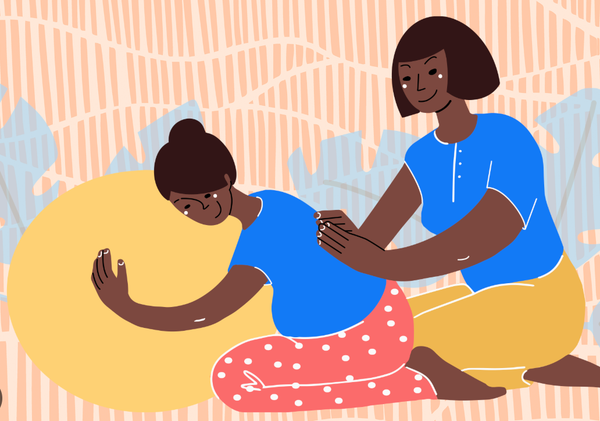
On Black Maternal Health, Ancestral Practice, and Building What Our Mothers Deserved
By Zetanefert Zipewtu, Founder, Our Mothers' Light Birth & Baby Village
On April 17th, I will walk back into a building that raised me. New Mount Pilgrim Missionary Baptist Church sits on the West Side of Chicago, the same West Side where Black women die in childbirth at rates that should be national emergencies, where infant mortality figures are treated like statistics instead of grief. And yet, this church held me. When my father was absent and my grandmother was doing everything she could to keep the lights on and my spirit intact, this church, its pastor, its elders, its pews, gave me structure, discipline, and love. I left that church eventually, drawn toward something older, something that remembered me before I remembered myself. But I never stopped being grateful. And now, fourteen years into my work as a doula and birth keeper, I am returning, not to go back, but to bring everything I've gathered forward.
This is what full circle feels like.
The panel I am sitting on, was organized by the very church (and many other community partners) that nurtured me and continues to nurture the very community it sits in. The discussion will center around the theme of Black Maternal Health Week 2026: Rooted in Justice, Rooted in Joy. We will be talking about how community-based care and support networks can work in concert with the healthcare system to improve outcomes for Black mothers and babies on the West Side, specifically in and around Garfield Park, where some of the highest maternal morbidity and infant mortality rates in the city are concentrated.
These numbers are not abstract to me. I grew up in the community these statistics describe. I know the names behind the data. And I know that what is missing is not care — it is infrastructure. The West Side has always had people who care. What it has lacked is a coordinated ecosystem: a web of doulas, midwives, birth workers, healers, community health workers, and families who are connected to one another and to institutional resources in a way that makes the whole stronger than the sum of its parts.
Building that ecosystem, a true birth ecosystem on the West Side, is the work I have committed my practice and my organization to. Our Mothers' Light Birth & Baby Village exists precisely for this: to serve families directly through doula and childcare support, and to build the workforce infrastructure that ensures this work continues and scales. When I sit on that panel with physicians and community members, I am not there as a guest. I am there as someone who was built by this community and who is building something back.
There is a conversation that happens often in Black liberation and healing spaces, one that places religion, and the Black church specifically, in opposition to the ancestral practices that were taken from us. And while there is real critique to be had, real harm that has been done in the name of respectability and spiritual suppression, I hold this conversation with complexity. Because the church did not ruin me. The church, in many ways, saved my life.
My grandmother made a choice. She knew what she knew, and what she knew was that a little girl growing up without her father needed walls around her, not to cage her, but to hold her while she grew strong enough to choose her own direction. The church provided that. The pastor served as a surrogate father during years when I needed one. And when I eventually followed my own calling, when I began training with Kebtah and immersing myself in traditional West African spiritual and healing practice, I did not leave in bitterness. I left with gratitude and a fuller sense of who I was becoming.
People only know what they know. My grandmother knew the church. She gave me what she had. And from that foundation, I was able to go find the rest.
Through my apprenticeship and continued study with Kebtah, I have been exposed to traditional pregnancy, birth, and postpartum recovery practices rooted in West African tradition — practices that have been carried forward with intention, that address the whole person across every dimension of their being: physical, spiritual, mental, energetic, psychological. These are not new discoveries. They are ancient technologies that never stopped working. What changed was access.
I have watched these practices transform women. I have witnessed postpartum healing that moved faster and deeper than anything I observed in clinical spaces. I have sat with mothers during labor who, supported by ancestral ritual and intentional care, moved through birth with a grounded power that the hospital model cannot manufacture. I have seen babies welcomed into the world in ways that honor them as spiritual beings, not just biological events. And I have seen the effects carry forward, into how those mothers bond, how those babies develop, how those families hold themselves together.
Hundreds of women. Hundreds of children. The data is in the lives.
What I recognize clearly is this: there is a gap on the West Side that is not simply a gap in medical access. It is a gap in ancestral knowledge. The women in Garfield Park who are dying in and after childbirth, who are not being heard by their providers, who are navigating postpartum depression without community, who are raising children without the intergenerational scaffolding that sustains a people, they are not failing. They are being failed by a system that was never built to hold them. And they are being failed by a disconnection from the practices that were designed specifically for them.
I have been exposed to what fills that gap. I have the obligation to bring it home.
When I take my seat at that table on April 17th, alongside doctors, alongside community members, inside the walls of the church that raised me, I will be holding all of this at once. The girl who was kept in the church by a grandmother who loved her. The practitioner who left to find something older. The doula who has attended births in hospital rooms and living rooms and spaces in between. The founder who is building the infrastructure this community deserves. The apprentice healer who has been trusted with ancient knowledge and feels the weight of that trust.
The theme of this year's Black Maternal Health Week — Rooted in Justice, Rooted in Joy — is not a tagline to me. It is a lived description of what I am trying to build. Justice looks like birth ecosystems on the West Side. It looks like doulas with Medicaid billing access. It looks like community-based childcare that supports families from their first trimester forward. It looks like traditional postpartum care being offered alongside clinical support, not in opposition to it.
And joy! Joy looks like a child of the West Side coming back to her grandmother's church with her whole self intact. It looks like a pastor who served as a surrogate father watching that child stand up and speak about building a safety net for the next generation of Black mothers and babies. It looks like the practices of Kebtah finding their way into communities where they were always meant to be.
We are not starting from scratch. We are returning to what was always ours.
If you are a Black woman on the West Side of Chicago who is pregnant, postpartum, or simply trying to understand what it would feel like to be truly held through the process of bringing life into the world — I want you to know that there are people building something for you. Not a program. Not a grant initiative. A living, breathing village.
Our Mothers' Light Birth & Baby Village exists to connect families to doula support, to community care, to resources across Garfield Park and the broader West Side, and — for those who are drawn to it — to the ancestral wisdom that has always known how to welcome life and protect the women who carry it.
I came from here. I am building here. And I am bringing everything I know home.
——
Zetanefert is a doula, cultural activist, childbirth educator, and founder of Our Mothers' Light Birth & Baby Village — a doula and childcare collective serving Chicago and the South and Western suburbs. She is an apprentice healer with Kebtah and a practitioner of traditional West African spiritual and healing traditions. She has fourteen years of experience in birth work and is an advocate for Black maternal health equity and doula workforce development in Illinois.