Cultural Reform: Eliminating Divisions in Burkina Faso Schools
– 6 min read

by Nezeziyah Sakuhai
One recent evening, my hair braider and her friend finished installing Fulani braids on my girls. I asked them to add beads. The leading stylist warned, “If I put these on their hair, the people are going to chase them around at school.” This scenario sounded like pulp fiction. When I asked who and why, she said that a new rule was in place at all schools: girls cannot wear beads. Still, I thought either she was misinformed or trying to avoid the task at hand. “My girls go to an international school, and it is not a problem there,” I insisted. I eagerly ran to grab the shimmery beads that I purchased during our recent trip to America. With the finishing touches added, my girls looked so glamorous.
A few days later, my children returned home after school, sweaty and perturbed. My girls urged, “The teachers said we have to take the beads out of our hair. We have to take them down before we go back on Monday.” My oldest son insisted, “Our teachers said we have to get haircuts. Girls can’t wear mesh or beads, and boys have to have haircuts.”
Then, before Monday even came, my youngest girl told me that her name had been added to her teacher’s non-compliance list. The boys said that the authorities were coming to the classroom and intimidating the kids who had no haircuts; he begged to be sent to a barber. The problem was that I didn’t know where they could walk that wasn't too far. The barber within walking distance closed his shop while we were traveling. Lately, my husband took them for touch-ups, but he was traveling again. Hearing all this, I tried not to be irritated. Eventually, I unraveled the beads from the girls’ hair; on Friday, a barber in our community cut my three school-aged boys' hair at his home. Almost bald, the boys will make their debut tomorrow.
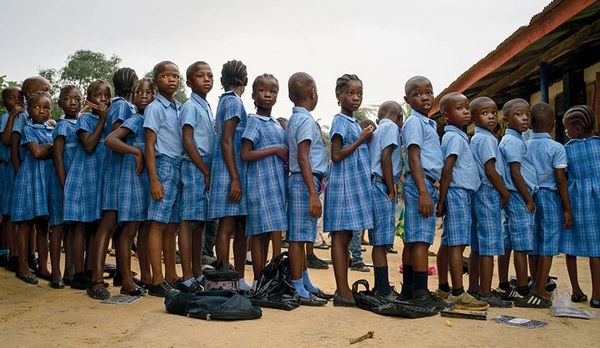
My friend teaches at a local school across the street from my children’s. Today I interrogated her about the policy, which she verified is real and currently in effect. Burkina Faso President Ibrahim Traore has mandated that students nationwide wear a simple standardized hairstyle. Haircuts must be really short. If girls do keep their hair, it is braided into simple cornrows. Synthetic hair and embellishments (including beads) are strictly banned in all Burkinabe schools, including both public and private sectors. The ban applies to all levels of schooling, including primary, vocational, and non-formal schooling.
(Notably, President Traore plans to finish society's use of skin-lightening products once he successfully implements the hair rule in schools. Already, he has banned the promotion and acceptance of skin-lightening products in the country.)
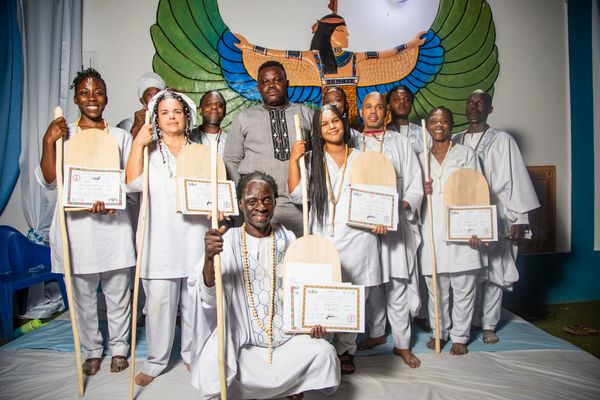
On the one hand, as someone whose family repatriated to Burkina Faso to join our community's efforts to reclaim Kemetic culture, I had additional doubts. Many children in the community have attended colonial school and participated in M’tam Initiation at the same time. This new rule at their colonial school didn't sound like what we signed up for. Considering this, I then told my friend, “Fulani braids are traditional. These beads are traditional, right? He is going to suppress cultural expression?” She replied yes and no. “Those beads are not traditional. Traditional beads are wooden, etc.” Mine were plastic. As it turns out, most beads supplied in Burkina Faso are made in China.
Interestingly, Burkina Faso is not the only country to start placing this ban. So, I had to look more into the ban’s significance. Especially because I realized there is such diversity amongst the students in Burkina Faso’s schools. Historically, indigenous hair-braiding practices have signified things like which tribe one comes from. So why would the President, a staunch advocate of traditions and revolution, authorize this policy?
On the other hand, I appreciated the ban as a tool to combat pervasive colonial ideology. This ideology condemns Black girls’ natural hair.
Furthermore, the ban comes at a time when Western news outlets have highlighted risks associated with wearing synthetic hair. A United States-based consumer advocacy group, Consumer Reports, tested ten major synthetic hair brands and found the presence of carcinogenic elements; all ten brands contained cancer-causing agents, and nine contained unsafe levels of lead. These brands share the same supplier; they are commonly sold to black women worldwide. Considering this, the ban will help students dodge a bullet. Although when school is out, that’s another story.
Some of the benefits of the ban were evident. However, more insight into President Traore's agenda comes from national news outlets. The private TV channel BF1 is one source that covers this issue. It features interviews with students and principals. According to one Burkinabe student, “Kids get kicked out of school because their hair did not fit the new rules. If you do it simply, it's good, but if you do all that extra stuff, you can’t come back to school.” In footage, students lined up outside the gates of one school and were inspected by staff one by one. Even girls removed their scarves at the gates. Offending students everywhere have been expelled from school. My son informed me that his friends in our close-knit community were expelled from school in the same way. Another prescribed punishment had been to deny schoolchildren access to the school's recess areas.
The disgruntled Burkinabe students on TV debated the fairness of the decision. One girl pointed to a caveat– female students who wanted to attend certain events outside of school would be forced to cover their braids with wigs to meet the entry requirements.
Nonetheless, the ban is righteous. It “aims to put students on the same level and it reduces social divides.” Noufou Ouedraogo, a Burkinabe parent, shared, "I think it's a very good idea because success starts with discipline. On the economic level, I also think it's really the right thing because there are parents with limited means who cannot always spend large sums to have their children's hair braided."
Paul Marie Karanga, Principal of Marien N'Gouabi high school, said, "This measure comes to standardize the children, like the school uniform. What does standardization mean? Standardized means there are no rich students and no poor students. We are all students." He continues by calling on the support of parents. "Because honestly, we can't make mend without breaking some eggs. If we want education in Burkina Faso to be what it should truly be, we need to get involved. We need to contribute our part. Because in reality, we bring children into the world. We entrust them to educational institutions, but still, we are the biological fathers. We are the biological mothers. It’s up to us to understand that education starts at the foundation.”
Perhaps at some point, I overlooked a notice sent home to parents. Or maybe my kids missed the memo altogether, as they started the school year late. After returning from a trip to America in January, our kids continued their formal education mid-school year. At first, I didn't know why the authorities were threatening kids. I just knew my kids needed to go back to school. As a more informed member of society, I do respect the enforcement of these rules. They potentially bring more order, uniformity, and harmony within schools.
Conversely, in other African countries, including South Africa, the problem is reversed in some schools. Schools require children who are not white or mulatto to cut off their hair, while white girls are allowed to keep their hair in buns, for example. This would be an example of discrimination, division, and planting seeds of internalized racism.
If I were in the position of the Burkinabe students, especially girls, honestly, I might be disappointed or relieved depending on how I viewed my circumstances. I might be the girl with no voice, but who recognizes that her family is too poor to afford more elaborate styles. Or, like my girls, I might be cognizant of the toxins in synthetic hair and willing to choose health. Or, like those girls on TV, I might feel like my freedom of expression was being violated.
At the end of the day, students need to make the best of the situation. Within colonial institutions, there are often social pressures and obligations to enhance one's beauty with weaves, hair extensions, and hair straighteners. Students now have the opportunity to navigate school with a shared focus on education. Students, many of whom started wearing weave at two or three years of age, will even have the chance to see that you can survive on simplicity. It's just hair in the grand scheme of things. When school is out, kids can switch back to the styles that allow cultural and self-expression. Balance is key, and the new guidelines promote this too.