Dogon: The Living Heirs of “Ancient Egypt”
– 6 min read

by Nehez Meniooh
"The Motherland has been reduced to a mere reserve of minerals and wildlife, denying us all aspects of our identity."
-Neb Naba Lamoussa Morodenibig, Dogon high priest and teacher of Kemetic wisdom
Indigenous Africa is one of the most misunderstood civilizational continuums on Earth. The idea that Nile Valley social structure still exists and connects terms like Dogon, Maasai, Kemet, and Pharaoh to a common origin seems far-fetched to many academically trained readers. Yet it is precisely this living continuity that our organization points to when we speak of Dogon traditions and their connection to ‘Ancient’ Egypt. As more well-intentioned scientists admit that human life and civilization originated in Africa, the modern view is that pre-colonial African civilizations are outdated, lost relics consumed by time, leaving only loose, primitive tribes with no writing system or meaningful contribution to modern civilization.
Today, African societies are shrouded in mystery. While the social media era shines more light on the intricate cultures throughout Africa and their undeniable refinement and maturity, our approach to those cultures has been shaped by the fervent work of the colonial era and organizations like National Geographic. The result is a lens closer to observing Nature’s wildlife than recognizing in these cultures our human roots and civilizational authorities. Overwhelmingly, that work succeeded in disconnecting the continent’s many people from their Nile Valley roots.
Perhaps the simplest example lies in nomenclature. Even the everyday names we use already reveal how confused we are. The name “Africa” is new, especially when contrasted with the continent's civilizational age and history. It was never used by the mothers and fathers of civilization, the early inhabitants of the continent.
Romans began referring to the Northern territory of the continent by that name, “Africa,” around 146 BCE after finally defeating the stronghold of Carthage. It was not used across the entire continent until around the 15th century, when European invaders pushed farther inland. Before that, the name Ethiopia was commonly used to speak about the southern, more expansive region. Both names are similar in meaning: Africa, in the hieroglyphic language, means “burnt spirit,” and Ethiopia means “burnt face.” In this context, both terms were derogatory. The Romans called the people of Carthage ‘Africans’ as a resentful retaliation, a way of avenging the honor of their predecessors, the Greeks. The Greeks, who came to learn in the temples, had been named Ger-ka by the Kemetic priests. Ger-ka meant “spirits in darkness” or obscurity and highlighted the lack of culture and refinement that the Greeks brought to the temples, as they asked to be initiated. The origins of the name Ethiopia are not entirely clear, yet it remains clearly derogatory.
Today, we often use the phrase “Indigenous Africa” to try to point back to Kemet and to the continental civilization that mothered humanity. But even this word “indigenous” is not ours. Its earliest recorded use for people appears in the 17th century, in the writings of Sir Thomas Browne, an English imperial physician, contrasting the “native” populations of the Americas with the Africans who had been enslaved and transported there. He was writing from inside a racial order where Europeans sat above the labor and lands they were exploiting. In that order, he described the African presence in the Americas as “unnatural” because it had been uprooted from its original land. Only in the 1960s did “indigenous” begin to be reclaimed as a political identity, a banner of shared struggle against imperialist domination, carrying meanings of land-based continuity, collective rights, self-determination, refusal, and resistance.
So, when we say “Indigenous Africa” today, we are forced to borrow a term invented by colonizers to categorize and subordinate us, then partially reclaimed as a tool of resistance. It can serve as a quick association in the modern mind. But it is still a poor substitute for the civilization that knows itself as Kemet and for the peoples of Meritah, the original name of the continent now called Africa, defining themselves on their own terms.
The original name of the continent was Meritah (meaning ‘our beloved land’ in hieroglyphs). Kemet (or ‘the black lands’ in hieroglyphs), the Nile Valley civilization was shared by the vast array of tribes across the continent of Meritah and beyond. The most pertinent part of that history for this article is the long, almost unbelievable span of invasions and conquests that took place there.
The last authentic Pharaoh (sovereign of the Nile Valley and King of all Kings of the African continent), Ramses II, ruled from 1279 BCE to 1213 BCE. By that time, invasions of the Nile Valley by Northern tribes had become routine over about 2500 years. Previous Pharaohs had done wonders to resist and immobilize invasions. The position of Pharaoh is difficult to comprehend today. Today, people often compare the Pharaoh to the President of the United States, often called the leader of the free world. But this comparison quickly breaks down once we consider how corporate interests influence the President’s decisions. The comparison is even more misleading once we remember that the Presidency is a political position, whereas the Pharaoh was not.
On the Pharaonic throne sat one person, a figure who represented the elite of society. It was this whole society that took responsibility for ruling and ensuring that the people of Earth could live in a way that served their spiritual evolution before death. They were elite, not because they achieved power by might or swindling, but because they had proven a quality of wisdom and know-how (practical and spiritual) in their field, rising above their peers. The Pharaoh, as their representative, constituted the best of humanity before the Gods and personified a God in the flesh to humanity across the globe. The elite society that backed the Pharaoh was known as the Landlords, or the families with the knowledge and capability to take responsibility for life on Earth. Another term for "landlord" in Pharaonic culture is "Dogon" or "Dougoumba".
The Dogon, as a social order, migrated throughout Africa after the fall of Misra, the Nile Valley region later known as Egypt. It is best explained in the words of Dogon Priest Neb Naba Lamoussa Morodenibig
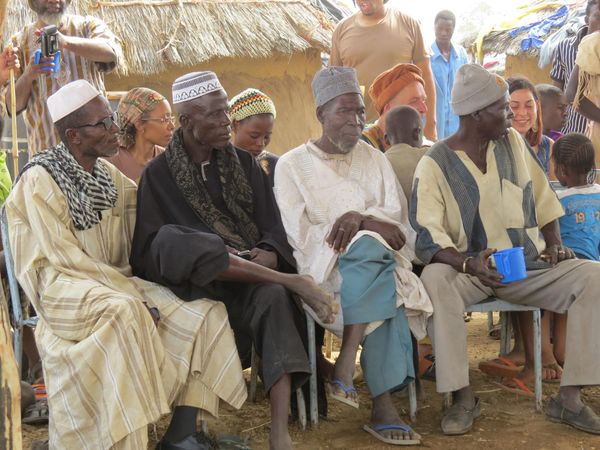
The Dogon, contrary to popular belief, are not just a small tribe that live in the cliffs of Mali. The Dogon are composed of many different bloodlines that represent the elite of the Pharaonic society. The Dogon once lived in the Nile Valley, but they migrated inland during the invasions around 400 BC. Today the Dogon live in many countries in West Africa. They are seen as the Kemetic people who, during the times of invasion, migrated so that their culture and spirituality could be kept pure. They are one of the most studied cultures in the world, they are often known among academia for their knowledge of astronomy and their link to the Sirius star (also known as Dog Star). However, the Dogon bloodlines hold a high knowledge of all subjects depending on the field and specialty of the specific bloodline. The bloodlines exist within the ethnic groups of the Gourmantche, Chibisi, Dogomba, Farafara, Sonike, Germa, and others. A few of the Dogon bloodline names and their fields are Naba (healers/priests/astronomers), Woba (farmers), Yonlis (guardians of the kingship), Kediou (builders), Mende (blacksmiths) and others...
Because the Dogon were so integral to Kemetic cultural integrity, each tribe, wherever possible after the migrations, designated some of its members to carry that responsibility of guaranteeing the value of their Ancestral culture and mastery over the secrets of life on Earth (from the Nommo, primordial water spirits and guides, to astronomy, the Sirius star, divination, medicine, and irrigation). Another portion would be dedicated to defending the civilization from threats, the warrior class, which was originally known by the name Maashai (today Maasai). This is what connects the modern tribes of Africa to their roots in Nile Valley civilization. This is what makes Nile Valley civilization an existing, surviving lighthouse not only for the continent now belittled by the name Africa, but for the entire human world.
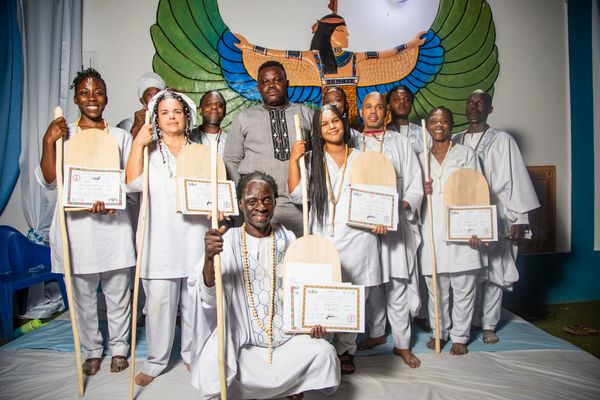
Across the globe, every indigenous people had to ensure that some among them carried enough spiritual education to maintain harmony between the members of the tribe and the land on which they live. Within this same principle, what outsiders today call Dogon traditional religion is in fact the organized spiritual science through which the Dogon lineages maintain harmony with the Nommo, the Ancestors, the land, and the Powers of Nature. This is why the mission brought forth by Neb Naba Lamoussa Morodenibig inevitably will gain the attention of honest human beings around the globe. For this reason, the work of his son and disciples, continuing his mission in KEBTAH, an organization working in alliance with the Dogon temples, dignitaries, and Gulmu (a traditional Dogon kingdom in West Africa) royalty back home in the Dogon lands, offers all indigenous peoples a huge opportunity.
In our attendance at indigenous unification events, it became clear that many of the tribes, seeing themselves as indigenous, were holding on as tightly and as best they could to their Ancestral heritage but knowingly lost a lot. Many held only clothing, cooking, or song, but lost the spiritual technology their predecessors used to maintain a harmonious connection to their Ancestral spirit, Earth, and its natural powers (mountains, rivers, forests, etc.) For any reader, of any family, clan, or tribe who knows that they have a disconnection that needs repair in order to realize themselves fully, the Dogon are Walking, the Dogon are Talking. They are not here to be merely heard or seen, but to make their contribution to the recovery of humanity’s place in the Divine Order. This is the living legacy our organization aligns with when we invoke the name Dogon and affirm our continuity with pre-colonial Kemet.