by NEB Naba Lamoussa Morodenibig
The last days of the sidereal year have been celebrated since the dawn of human consciousness (over 73,300 years ago) as a commemoration of the birthdays of Gods (Festivals of Sokari), and since the last two millennia under the name of Earth Festival. The Sokari Festivals celebrate the perfection of the astronomical calculations that are more than 73,000 years old. The time concept is a cycle of 1461 days based on the Sidereal declination of the Sirius star (Sothis) from the Orion constellation in relation to the sun.
These calculations imply a small Tehuti 403 year or a year of the season cycles with a period of 365 days and a quarter. Modern science, in a sort of guess and led mostly by ideology and a strong will for cultural cooperation, has simply fabricated explanations of a year based on the revolution of the Earth around the sun, knowing that one has to wait more than fifty seven years to see two similar positions in relation to the sun.
In the documents that have survived the destruction by those who said they would like to build a new civilization on top of the ruins of the knowledge that has enlightened the world, one can find a papyrus called "The Book of the Five Days of the Year". This book teaches about astronomical knowledge but from purely spiritual, metaphysical and, especially, cosmogonic angles.
"The Great God Ra placed the Goddess Nout and Geb together after he had created them, and when he was busy creating by his words the rest of the universe, he found that the Goddess Nout and the God Geb were making love. The great creator God was angered to see the rush in which the Goddess was trying to give birth. Let's notice that in this period, the year was only composed of twelve months of thirty days, which is 360 days. Ra then decided to punish the Goddess Nout, and this punishment was formulated in this way: from now on this is your destiny, for that you have only listened to your heart, I forbid that you give birth in the night or day during the whole 360 days of the year." The Goddess Nout became very unhappy with the idea that, because of her lack of patience, her destiny will be reduced to a Goddess that is incapable of giving birth. She went to see the Ennead, the committee of nine Gods, guarantors and managers of the stability of the Universe. These Gods felt pity for her and decided to create and add to the year five other days in which she could give birth to Wsr (Osiris) on the first day, Haroeris (Horus the Great) the second day, Seth the third day, Aseta (Isis) the fourth day and Neffisa (Nephtys) the fifth day, and every four years, a day of renewing the divine pact, and this day was called World Renewal Day.
This history is not simply to distract, it is a spiritual text containing astronomical knowledge. This text is not to be compared with any other text produced by modem civilization. It is astronomy as presented by those who have introduced it to humanity, those who have invented the scientific disciplines of history, geography and writing.
Let's reconcile with history. Let's reconcile with the cosmic cycles. Let's celebrate the birthdays of the five Gods.
The Sidereal Calendar is the only concept of time division that is based purely on astronomical knowledge. This calendar, in reality, is 73,300 years old and its quality still imposes itself onto all scientific works of modern astronomy.
Modern science and astronomy may be preoccupied by the idea of pleasing Roman clergy and other political leaders. Until now, they have found themselves not only carriers of the ideology of dominating social classes but also as the instruments of alienation and domination while in the hands of social politicians. In 300 of the Christian period when the Christian clergy announced that the world was only 6000 years old, their scientific worlds made it their duty to prove that the world was created exactly in the year 6324 182R before Christianity.
I can't stop smiling at the idea that the first calendar presented by Romans (before the Julian calendar) found itself in the year forty seven as being ninety days behind the cycle of Earth. This means that when the calendar was indicating winter, people were still farming because it was summer...
The list of consequences humanity has been victim of, and remains victim of, is endless. All of these confusions were happening with only one goal: the disorientation of humanity. A population that is disoriented is a lost population, without attachment and without values, and is easy for leaders and the politically powerful to manipulate. It was important for politicians to cut the attachments humanity had with nature and the cosmic realities of human existence, turning everybody into a stranger of the Earth.
The Sidereal Calendar, a time concept based on cosmic reality, puts all humanity on the same level according to cosmic forces.
The idea of a Medium year of 1461 days is composed of three small years of 365 days and one year of 366 days is 73,300 years old. Only one cycle is not affected by the instabilities of Earth's rotation of all of the cosmic cycles that involve Earth, and it is the cycle based on the Sirius of the Sothis star in the Orion constellation. Once every 1460 years a phenomenon called the Heliacal Rising of Sirius occurs, which means that the star is eclipsed by the sun. The period of 1460 years equals a Great Year, which can be decomposed into a Medium year of 1461 days. These numbers are from astronomical calculations and imposed themselves on the speculations of modern science.
The leap year has been explained by modern education as being related to Earth's revolution! The idea of a 365 1/4 day year based on the Earth's rotation is fake. Note that these ideas have been introduced by the same people that, in less than one millennium, were heavily debating about the shape and form of the Earth.
The world is a place of knowledge, If ignorance is a disease, pride and arrogance are the cemeteries. The future of humanity is in the hands of every individual.
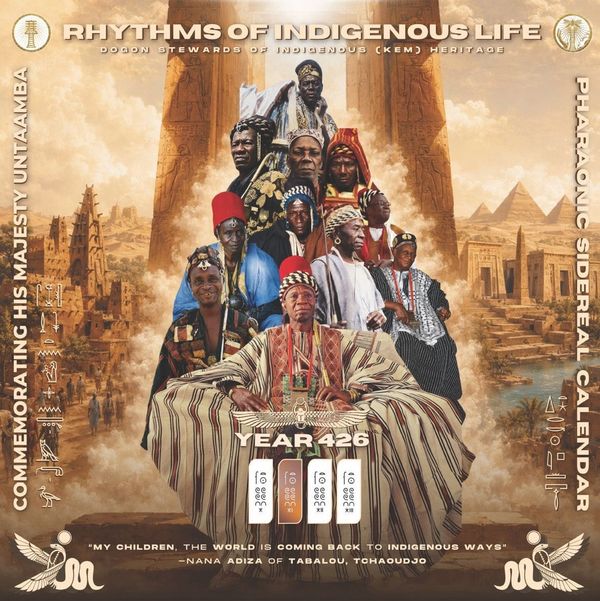
Get the new Calendar here: https://www.risingfirefly.org/shop/p/kemetic-sidereal-calendar-426