The Body As Loan, Not Brand
In Kemetic cosmology, the body is a continuation, a living archive of the people who shaped you. It carries their features, their resilience, their unfinished stories.
– 5 min read
In Kemetic cosmology, the body is a continuation, a living archive of the people who shaped you. It carries their features, their resilience, their unfinished stories.
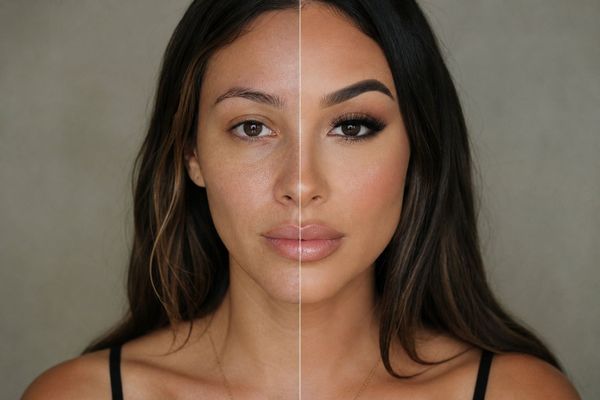
by Ameena Ahmed
How lifestyle aesthetics clash with ancestral law and how modern society manufactures narcissism through centuries of beauty control
Walk through any city, scroll through any feed, sit in any café long enough, and you’ll see it: people sculpting themselves through aesthetics. A certain kind of hair, a certain kind of glow, a certain softness or sharpness or curated ease. It’s become a language; one we all speak now, whether we ever meant to or not.
There’s nothing wrong with wanting to look good, or wanting to feel aligned with the person you’re becoming. But somewhere along the way, the body stopped being a home and started becoming a project. Something to manage. Something to refine. Something to keep up with. Something to compare. Something to display.
And that’s where the trouble begins. Because long before beauty became an industry, long before identity became something you could style, many cultures held a very different understanding of what a body is.
In Kemetic thought, the body isn’t a blank canvas. It isn’t even yours in the
way modern culture insists. It’s a loan, a vessel handed to you by Ancestors seven
generations back, carrying their features, their stories, their survival. And one day,
you’ll pass it forward. Hold that idea up against the world we live in now, and the contrast is almost violent.
Beauty Has Always Been a Tool of Power
Modern beauty culture feels new, but its logic is ancient. Empires have always used
beauty to shape behaviour, enforce hierarchy, and create desire.
In ancient Rome, pale skin signalled wealth while darker skin marked labour. In
Victorian England, women were encouraged to be faint, fragile, corseted: beauty as
obedience. Under colonial rule, European powers exported their own aesthetics
across continents, teaching entire populations that their features were inferior. Skin-lightening, hair-straightening, nose-narrowing — these practices didn’t appear out of nowhere. They were engineered.
Hollywood later took this further, creating the first global beauty template: thin, white, symmetrical, youthful. By the 1990s and 2000s, “heroin chic,” “video vixen,” and “Y2K nose jobs” taught entire generations that their inherited features were defects.
Today, we live in the age of aspirational narcissism, a culture that trains people to
obsess over their own image because it keeps them consuming.
None of this is accidental.
It is historical.
It is structural.
It is profitable.
The Modern Aesthetic Economy: A Self That Never Rests
Spend five minutes in a beauty aisle or on a lifestyle page and you’ll feel it: the
pressure to be better: smoother, firmer. more radiant, more defined, more “you,”
whatever that means this week. There’s always a new routine, a new treatment, a
new aesthetic to adopt. The body becomes a site of constant renovation, a place
where you’re expected to work quietly, consistently, endlessly. Transformation is
praised. Insecurity is monetised. Visibility becomes a kind of social capital. And
beneath it all, body dysmorphia rises, not as a rare condition, but as a cultural
baseline. When every image you see is edited, filtered, surgically enhanced, or cast
from a narrow mould, it becomes harder to trust your own reflection. Harder to
believe your face is allowed to exist as it is. The beauty industry knows this. In fact, it depends on it.
The global beauty market is worth hundreds of billions. It grows by convincing people— especially women — that their natural state is insufficient. Every “flaw” becomes a revenue stream. Every insecurity becomes a product line. Every trend becomes a new cycle of spending. People skip meals to afford injectables. They take out credit for cosmetic dentistry.
They work overtime for lasers, fillers, body sculpting, hair systems, skin lightening,
fat dissolving, brow lifts, lip flips, etc., the list grows every year.
Beauty becomes a subscription you can never cancel. The industry profits from the
gap between who you are and who you’re told to be. And the wider that gap feels,
the more money there is to be made.
The Manufactured Narcissist
We love to talk about a “narcissism epidemic,” as if people simply woke up one day
and decided to become self-obsessed. But narcissism doesn’t appear out of
nowhere. It’s cultivated. It’s engineered. It’s profitable.
Narcissism today isn’t vanity, it’s survival in a system that demands self-display.
We are taught to monitor ourselves constantly, curate ourselves for approval,
measure our worth through appearance, treat our bodies as personal brands,
compete for attention, and optimise every visible part of ourselves. This isn’t
narcissism as a personality trait. It’s narcissism as a cultural condition. Empires needed obedient bodies. Industries need insecure bodies. Modern society needs self-absorbed bodies. A self-obsessed population is easier to distract, easier to control, and easier to sell to. When you’re busy scrutinising your pores, you’re not scrutinising power.
Colonial Beauty: A Global System of Erasure
Colonialism didn’t just redraw borders, it rewired beauty itself.
Lighter skin became associated with civility and desirability.
Darker skin became associated with labour and inferiority.
Noses, lips, hair textures, bone structures, entire populations were taught these
were “wrong.”
Indigenous beauty rituals were dismissed as primitive.
And these ideas didn’t disappear. They globalised.
How Global Industries Carry Colonial Beauty Forward
Hollywood exported white femininity worldwide, (thin, symmetrical, youthful) while exoticizing or erasing everyone else.
Bollywood amplified colourism, making fair skin the default for desirability and
turning skin-lightening into a household ritual.
K-beauty fused Japanese colonial influence with Western aesthetics, producing a
homogenised ideal of pale skin, V-shaped jaw, double eyelids now exported
globally.
Across the Afro-diaspora, beauty has always been political. Natural hair
movements are acts of survival and reclamation after centuries of enforced
assimilation.
In Latin America, Eurocentric features dominate pageants, media, and advertising.
Cosmetic surgery and skin-lightening are widespread.
Across the Middle East, European features dominate even as traditional beauty
rituals persist as quiet acts of resistance.
Colonial beauty is global beauty.
Its fingerprints are everywhere.
How This Shows Up in Real Life
When the world shows only one kind of beauty, everyone else becomes “wrong” by
default. People begin to distrust their own faces. Inherited features become targets.
The nose your grandmother carried becomes a problem to solve. The skin tone
shaped by generations of climate and migration becomes something to correct. And the cost of beauty keeps rising. Beauty is no longer a routine. It’s a subscription. People stretch their budgets, skip meals, take out loans, and work overtime to afford treatments that promise belonging. Emotionally, self-worth becomes fragile. Culturally, colonial standards persist. Psychologically, anxiety deepens. Ancestrally, every “correction” interrupts a lineage. Spiritually, the vessel becomes a product. The cost is not just money, it’s memory!
The Kemetic View: A Body That Carries More Than You
In Kemetic cosmology, the body is a continuation, a living archive of the people who shaped you. It carries their features, their resilience, their unfinished stories. It carries responsibility.
You’re not the first chapter.
You’re not the sole author.
You’re a steward.
To reject inherited features is to reject the people who carried them through history.
This worldview isn’t about resisting change. It’s about resisting amnesia.
Beauty Without Forgetting
Beauty is not something you invent, it’s something you inherit. Your body is not a
brand, it’s a bridge. A bridge between past and future, between spirit and matter,
between who you are and who you come from. Aesthetics will keep shifting. But so
will the desire for rootedness. The question isn’t whether you participate in beauty
culture. The question is whether your participation honours the lineage that made
you possible. Because the body you shape today becomes the body your
descendants will receive. And the body you inhabit now is the body your ancestors
entrusted to you long before you arrived. The task isn’t to perfect the vessel. The task is to honour it.