The world will continue to offer distractions. Material success will continue to be sold as the highest achievement. Survival will continue to demand our time and energy. Yet beneath all of this lies a deeper responsibility.
As the anniversary of the last time the Gods presented themselves to humankind approaches, I find myself reflecting deeply on the responsibility I may not have chosen but still carry: the ancestral vow.
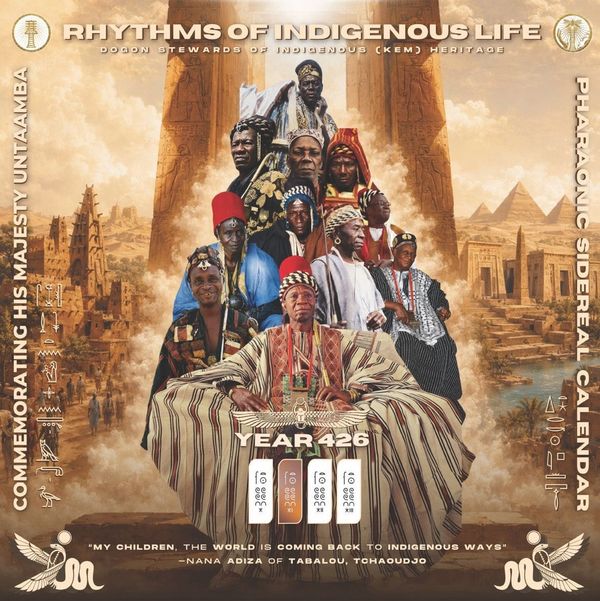
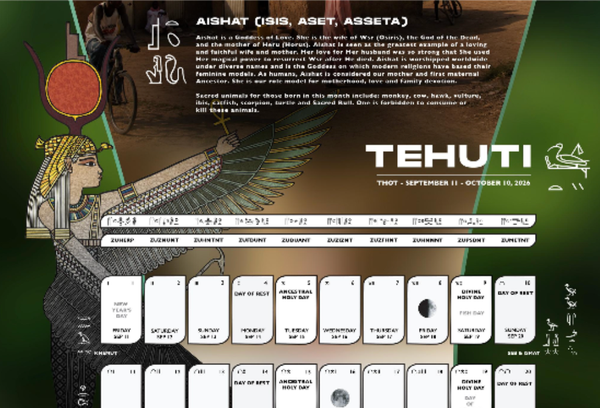
This anniversary marks more than a distant event. It represents a sacred covenant between humanity, the Gods, and our Ancestors. On the 19th of Tehuti (a date in the Pharaonic Sidereal Calendar rooted in ancient Egyptian (Kem) astronomy and science), our Ancestors were given knowledge, tools, and instructions to rise from a state of barbarism toward a higher state of human development. They were given a model to cultivate their qualities, transform their lives, and align their existence with a greater divine purpose.
Our Ancestors accepted this responsibility and made a vow to the Gods. This was not the decision of a single person or a small group. Each lineage agreed. The vow became a responsibility transmitted through the bloodlines, generation to generation.
Now, in the Gregorian year 2026 and the Pharaonic year 426, this responsibility stands before me. The vow is no longer just history or mythology. It is a living obligation that has arrived in my time, and ultimately, in my hands. I must ask: Am I honoring the commitment made before my birth? Am I doing my part to ensure that the torch continues to move forward?
The Meaning of the Vow
A vow has weight because it extends beyond personal preference and temporary circumstances. The ancestral vow is an agreement to use the instructions given by the Gods for the purpose of human elevation, not simply for information or status. These instructions were meant to produce transformation.
This distinction is essential. A person can receive teachings and still live according to the same destructive habits, limitations, and patterns that prevent elevation. The real sign that sacred knowledge has been received is how it changes the way we think, behave and relate to others.
The covenant therefore places a responsibility on each generation to cultivate its qualities. This cultivation requires continuous self-evaluation: examining one's character, behavior, thoughts, relationships, and actions. It asks us to recognize weaknesses instead of concealing them, consciously strengthen our gifts, and intentionally develop discipline, wisdom, integrity, consciousness, and self-mastery.
In this way, the ancestral vow challenges the idea that life is only about survival or personal achievement. It presents human life as a process of becoming.
Modern Distractions and Forgotten Purpose
One of the greatest challenges to fulfilling this vow is the modern environment in which we live. Today, society often defines success through material achievement: wealth, property, vehicles, careers, social status, and public recognition.
There is nothing wrong with acquiring material resources. Providing food, shelter, safety, and stability is an important responsibility. The problem arises when these goals become our only purpose.
A person can become so fixated on earning money that there is no time left for self-examination. Another can chase possessions until material accumulation becomes their identity. Someone else can spend an entire lifetime trying to meet external expectations, without ever asking what their deeper purpose might be.
Often, this is not a conscious choice. Many people are simply trying to survive, working to maintain housing, feed their families, care for children and elders, manage debt, and respond to emergencies. These pressures are real and must be acknowledged.
However, survival and spiritual elevation do not have to be in conflict. Survival is a condition of life, but not its ultimate purpose.
The modern world makes it easy to forget this.
The pursuit of material security can distract us from inner development. The demands of society can become so loud that people lose connection with their Ancestors, their culture, their spiritual responsibilities, and their true purpose.
The annual remembrance of the ancestral covenant on the 19th of Tehuti is a moment to interrupt that pattern. It invites us to step back and return to ourselves.
The Responsibility of Self-Evaluation
The 19th of Tehuti is a dedicated time for serious reflection and accountability.
It is a time to ask: Where am I now, compared to where I should be? What qualities have I developed since last year? Where have I remained the same? Where have I improved? Where have I fallen short? What habits must be corrected? What distractions have pulled me away from my purpose? What lessons have I received but not yet applied? These questions are not meant to create guilt or shame, but awareness. Without honest self-evaluation, growth cannot occur. No one can correct a problem that they refuse to see, nor can they elevate a quality they have never paused to examine.
The anniversary becomes a form of sacred accountability. It is a time to step away from daily noise, to meditate, to reflect, and to ask whether our actions support the elevation of ourselves, our families, our lineage, and ultimately humanity.
The day is meaningful, not only because of what happened in the past, but because of what we choose to do with what happened.
Carrying the Torch Across Generations
Ancestral responsibility can be pictured as a torch.
A torch is passed from one person to another. The person who receives it did not create the flame, but. they become responsible for protecting it and keeping it alive.
I did not create the covenant. I was born into its continuation.
Those before me carried the responsibility as far as they could. Their efforts, their sacrifices, and their understanding created the conditions that allowed this vow to reach my generation. Now it is my turn to carry it.
Carrying the torch should not mean freezing it exactly as it was. Each generation has a responsibility to elevate what it receives.
I must receive the torch, strengthen it, deepen it, and then pass it forward.
The next generation should not receive less than what I received. Ideally, they should inherit more: a greater understanding, a stronger character, a deeper knowledge, and a more developed capacity to fulfill their own responsibilities.
This is ancestral continuity.
Our responsibility is not only to look backward toward the Ancestors, but also to look ahead toward those who have not yet arrived. Our actions today are part of their inheritance.
Cultural Reconnection and Recovering Purpose
Cultural disconnection makes this vow harder to recognize.
When people are separated from their history, traditions, spiritual systems, and ancestral frameworks, they often adopt foreign definitions of purpose without questioning them.
Life becomes centered on money, status, image, and validation. These pursuits can occupy a lifetime without ever touching the spirit or deeper self.
Cultural reconnection opens the door to another way of understanding human purpose.
Through reconnection, a person encounters the knowledge and wisdom of their Ancestors. It builds a bridge between the past and present, reminding us that we are part of something larger than the individual self.
This is why I am deeply grateful to my teacher, the Maakheru, Neb Naba Lamoussa Morodenibig.
By honoring the responsibility of his own Ancestors and dedicating his life to cultural reconnection and the healing of humanity, he created a path for people like me to rediscover this ancestral responsibility. Without his work, these teachings and this vow might have remained hidden from me.
Receiving this knowledge creates another layer of responsibility.
I cannot only admire the teachings.
I must practice them.
I must allow them to transform my qualities.
I must allow them to guide how I live.
And ultimately, I must contribute to their continuation and transmission.
The Honor Within the Weight of Responsibility
Ancestral responsibility can feel heavy. Knowing that generations before me made a vow, and that I now hold a place in continuing it, creates a deep sense of accountability.
But this weight is not a burden.
It is an honor.
To stand on behalf of one's lineage is an honor. To receive teachings that can elevate a human being is an honor. To have a chance to correct oneself, grow in character, and offer something meaningful to future generations is an honor.
The weight of the torch reveals the importance of the work.
It reminds me that my life has significance beyond my immediate circumstances. I am not only an individual trying to navigate the modern world; I am also a living link in an ancestral chain.
Those who came before me are present in the responsibility I carry. Those who will come after me will be affected by how I carry it.
This understanding changes how I view my choices.
Every decision can strengthen or weaken the chain.
Every quality I develop can support those who follow.
Every weakness I refuse to face can become something that I pass forward.
For this reason, personal development is never only personal. It is ancestral, generational, and communal.
Returning to the Purpose of Life
The anniversary of the covenant calls me to distinguish between what is necessary and what is ultimately purposeful.
There will always be bills to pay, families to care for, work to complete, and crisis to manage. These responsibilities are part of human life.
But they are not the full measure of why I am here.
My purpose cannot be limited to acquiring material possessions.
My purpose cannot be limited to meeting society's standards of success.
My purpose must include the elevation of my qualities and the fulfillment of the responsibility inherited from my lineage.
This means that I must continually return to the work.
When I become distracted, I must return.
When I become discouraged, I must return.
When I see my own shortcomings, I must return.
When I experience success, I must return.
The work of elevation does not end just because circumstances improve. It is an ongoing, lifelong process.
Happy 19th of Tehuti!
The 19th of Tehuti is a powerful reminder that our present choices are connected to the responsibilities of the past and the possibilities of the future.
Our Ancestors received tools and instructions meant to raise humanity beyond barbarism. They vowed before Gods to use what they had been given and to continue the work of elevation. Each lineage took part in this covenant, and the responsibility has been carried across generations.
Today, that responsibility rests with us.
In the Gregorian year 2026 and the Kemetic year 426, I recognize myself as part of this living chain. I cannot change the fact that I inherited the vow, and I do not wish to escape its weight. Instead, I seek to understand it more deeply and to become more capable of fulfilling it.
The world will continue to offer distractions. Material success will continue to be sold as the highest achievement. Survival will continue to demand our time and energy. Yet beneath all of this lies a deeper responsibility: to cultivate ourselves, elevate our qualities, honor our Ancestors, and prepare the way for those who will follow.
The torch is now in my hands.
I must carry it consciously.
I must protect its flame.
I must elevate it.
And when my portion of the journey is complete, I must pass it on stronger than I received it.
This is not simply a remembrance of the past.
It is a responsibility in the present.
And it is a commitment to the future.
I offer my deepest gratitude to my teacher, the Maakheru, Neb Naba Lamoussa Morodenibig, for his teachings, his wisdom, and his dedication to preserving and sharing our cultural knowledge.
I am also grateful for his vision in creating Kebtah, a platform through which this ancestral wisdom can be shared with all of humanity. May these teachings help us reconnect with our ancestral heritage, honor those who came before us, and stand with greater understanding, dignity, and purpose.
Ntr Dua to all my teachers for keeping this knowledge alive and making it available for future generations. 🙏🏿